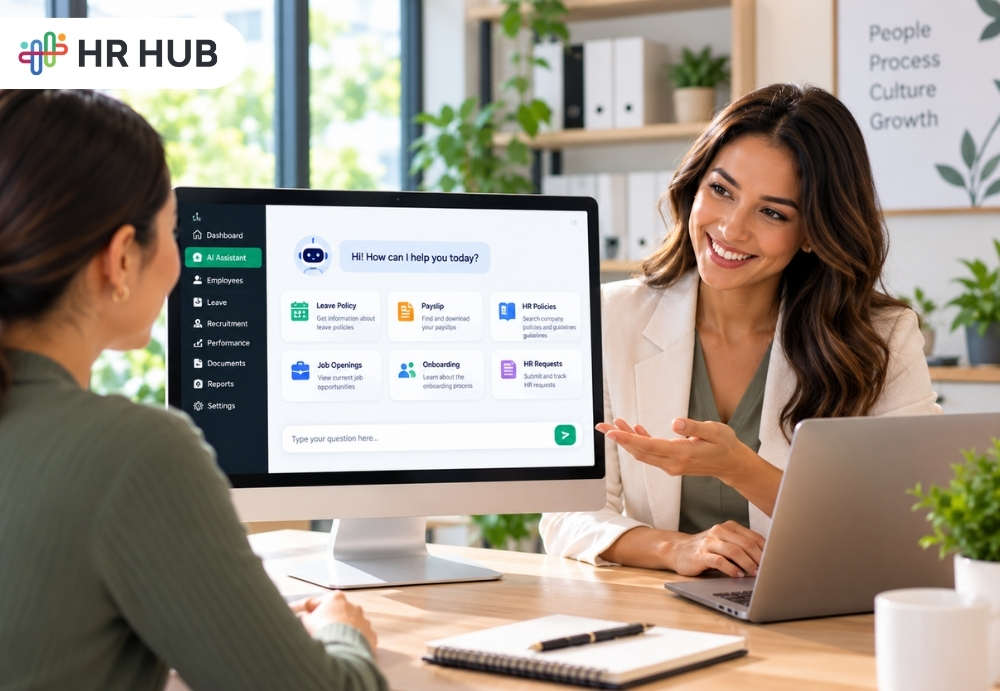
AI is moving from something HR teams talk about to something they can use in everyday work. Employees want quicker answers, managers want information without waiting for HR, and HR teams are expected to manage more data and processes without spending more time on repetitive administration.
But there is a more useful question than, “Can AI do this?”
It is: Where can AI actually help HR without taking away human judgment?
That question matters because HR deals with employee information, workplace policies, recruitment, payroll, performance, and decisions that can affect people's careers. The right use of technology is not about automating everything. It is about removing repetitive work, making information easier to find, and helping HR teams focus on situations where experience and human understanding matter.
This is where AI HR assistant software can play a practical role. It can help answer routine questions, find HR information, support recruitment activities, summarize reports, draft communications, and guide employees toward the right HR process.
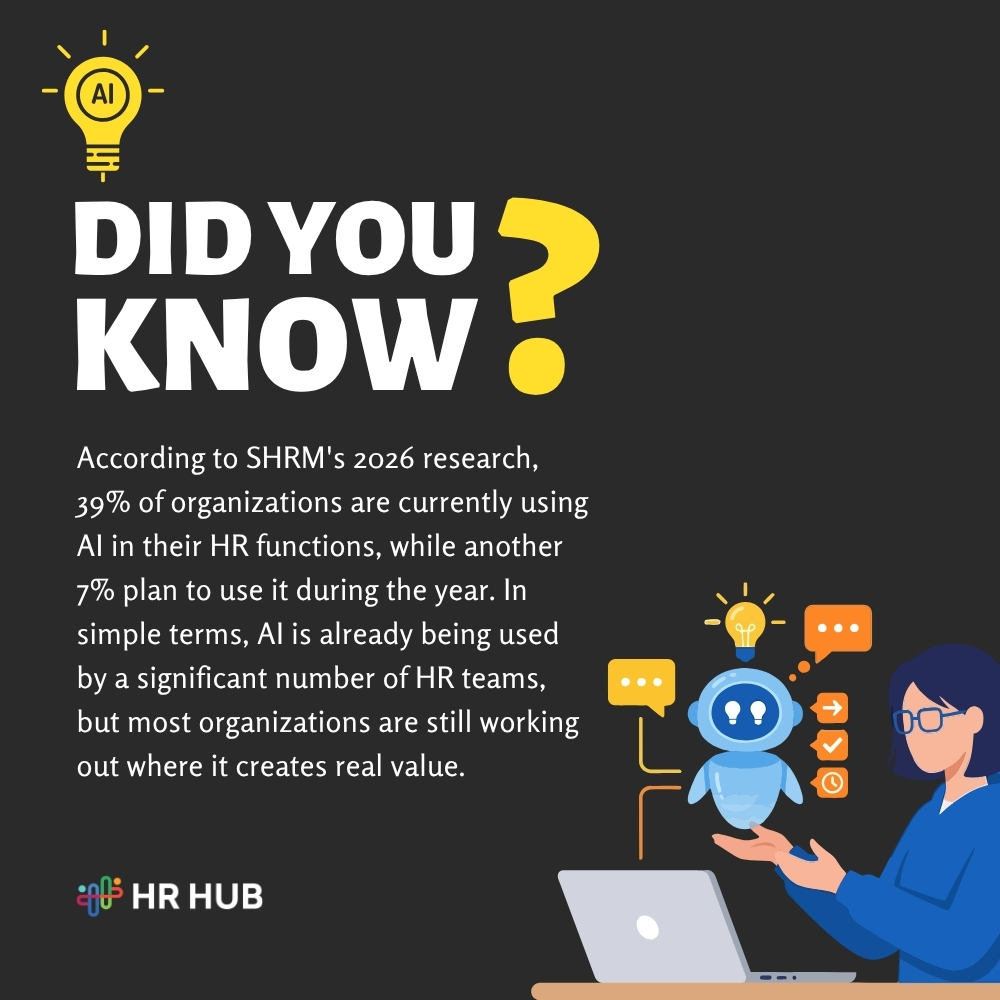
What Is an AI HR Assistant?
An AI HR assistant is software that uses artificial intelligence to help employees, managers, and HR professionals find information or complete defined HR tasks. Think of it as a digital helper connected to an organization's HR information and processes.
An employee might ask:
“Where can I find the leave policy?”
“How many leave days do I have?”
“Where can I download my payslip?”
“How do I submit an HR request?”
A manager might ask:
“What is the onboarding process?”
“Which requests are waiting for approval?”
“Where can I find this employee's information?”
An AI assistant for HR can understand these questions, find relevant information, and guide the user toward the appropriate answer or process.
Modern AI HR assistant software can go beyond simple question-and-answer interactions. Depending on the system, it can summarize information, support recruitment tasks, identify missing data, prepare drafts, and help move routine workflows forward.
This distinction is important. A chatbot that answers questions can be useful, but an AI assistant for HR becomes more valuable when it can connect the answer with the next appropriate action.
AIHR describes modern HR assistants as tools that can answer HR questions, surface policies, support onboarding, and reduce repetitive administrative work. It also points toward newer assistants that can support multi-step tasks rather than simply responding to questions.
The assistant should still operate within defined permissions, trusted information, and appropriate human review.
AI Assistants Are Moving into Everyday HR Tasks
HR already contains many repetitive activities. Employees ask similar policy questions. Recruiters review applications and arrange interviews. HR teams prepare reports. Managers are waiting for approval. Employee records need regular updates. Documents need to be issued and acknowledged.
These tasks are necessary, but they do not always require a person to perform every step manually.
This is where AI HR software can provide practical support. Instead of replacing HR professionals, it can sit alongside existing HR processes and handle defined, repeatable activities.
For example, an AI assistant for HR could answer a routine policy question and direct an employee to the relevant process. It could help a recruiter organize candidate information. It could summarize a workforce report so an HR manager can spend more time understanding the findings.
This is also where AI-Powered HR automation becomes useful. Automation does not have to mean handing an entire HR process to a machine. It can simply remove a few repetitive steps that slow the process down. The best starting point is usually work that is frequent, predictable, and easy for a person to review.
Where HR Teams Can Use AI Support?
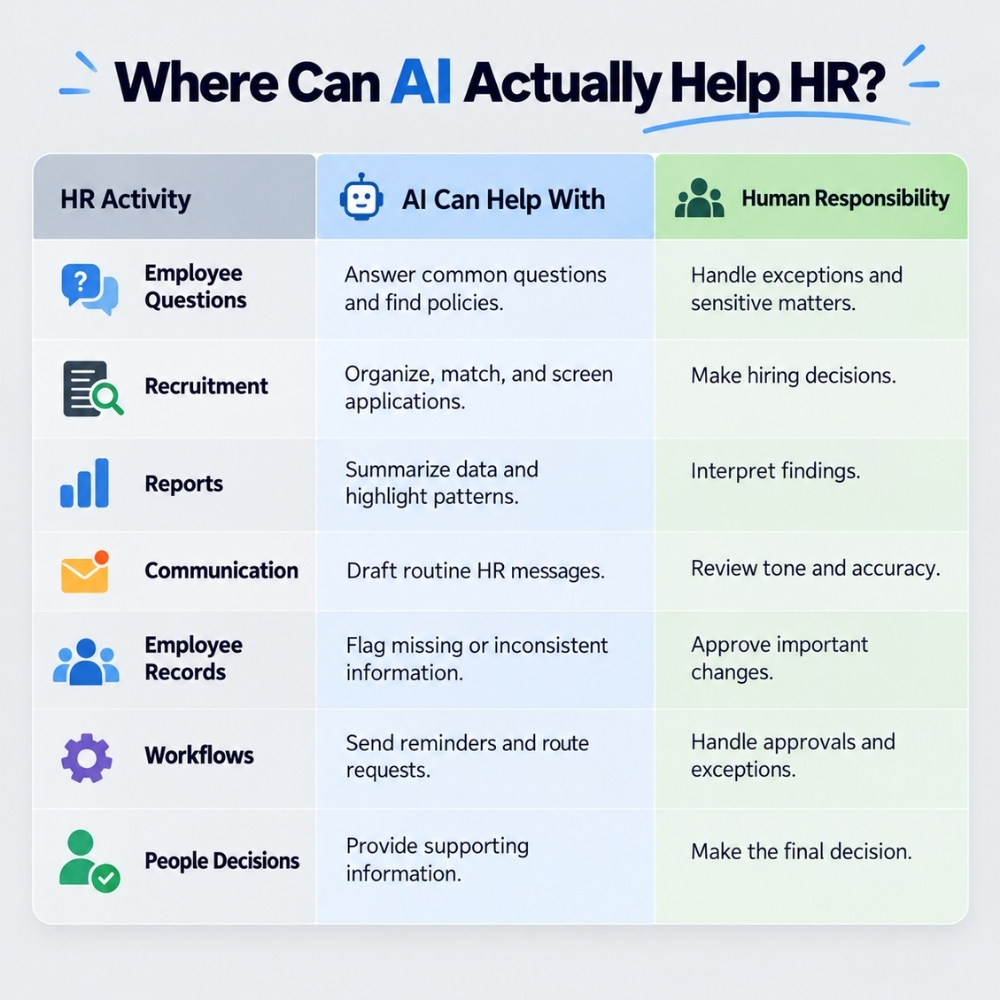
1. Answering Everyday Employee Questions
One of the clearest uses of an AI assistant for HR is employee self-service. Employees regularly need information about leave, policies, documents, payslips, benefits, working arrangements, or HR procedures. They may not know where the information is stored, or they may send HR questions that have already been answered many times.
An AI assistant can provide a first level of support by finding approved information and presenting it in plain language.
For employees, this can mean quicker access to routine information. For HR, it can reduce repetitive questions and give the team more time for employee concerns that need personal attention.
The quality of the answer depends on the information behind it. An assistant should rely on current, approved company policies and HR data rather than generating an answer simply because it sounds reasonable.
2. Finding HR Information Faster
HR teams deal with a large amount of information. Employee records, policies, procedures, reports, documents, recruitment information, and historical records can all become difficult to locate as an organization grows.
An AI HR assistant software can help users search for this information through natural-language questions instead of requiring them to remember exactly where a document or record is stored.
This is one practical application of artificial intelligence in HR. Employees and HR professionals can describe what they need in normal language, while the system searches relevant information.
For example, instead of navigating several HR screens to find a particular policy, an employee could ask where the policy is located and receive guidance based on the organization's approved information.
The system should also make it clear when information cannot be found rather than creating an answer.
3. Supporting Recruitment
Recruitment is another area where AI HR software can reduce repetitive administration. Recruiters may need to review large numbers of applications, compare candidate information against job requirements, arrange interviews, send communications, and keep candidates updated. AI can support tasks such as:
Resume parsing
Candidate matching
Application organization
Interview scheduling
Candidate communication
Job description drafting
SHRM's research shows that recruitment is already one of the strongest areas for adoption of AI. Its 2025 research found that 51% of organizations were using AI to support recruiting activities, with common applications including job-description writing, resume screening, candidate searches, and applicant communication.
The important boundary is that AI can support the recruitment process without becoming the final decisionmaker.
An AI assistant for HR may help highlight candidates against predefined requirements, but recruiters and hiring managers should still assess experience, context, communication, suitability, and other factors that automated screening may not fully capture.
4. Summarizing Reports and Workforce Data
HR teams often work with reports covering attendance, leave, recruitment, employee information, performance, and other workforce measures.
Reading large amounts of information and turning it into a useful summary can take time. AI HR software can help summarize workforce data and highlight patterns or changes that deserve attention.
For example, an HR manager may want to know whether absenteeism has increased within a department. AI could summarize the relevant data and identify the change. But the system cannot automatically explain why it happened.
The manager may discover that the increase relates to seasonal illness, staffing changes, workload, shift patterns, or another workplace issue. This is where artificial intelligence in HR should support analysis rather than replace interpretation.
AI can help answer, “What changed?”
HR needs to answer, “Why did it change, and what should we do about it?”
5. Drafting Routine HR Communication
HR teams write a large number of routine messages. These may include:
- Interview invitations
- Onboarding instructions
- Approval reminders
- Policy announcements
- Training notifications
- Employee updates
- Follow-up messages
HR automation AI can help prepare an initial draft based on approved information or templates.
That can reduce the time spent starting every message from a blank page.
Human review still matter. HR professionals should check whether the message is accurate, appropriate for the audience, and suitable for the situation before it is sent.
This is particularly important for sensitive employee communications where tone and context can matter as much as the information itself.
6. Supporting Employee Record Updates
Employee information changes throughout the employee lifecycle.
An employee may change their address, update their bank information, move to another department, receive a new designation, change managers, or take on a different responsibility.
An AI assistant for HR can help identify missing information, guide employees through the appropriate update process, or flag inconsistencies for review.
This can reduce administrative follow-up, especially when HR teams manage large workforces.
The assistant should not quietly make sensitive changes without appropriate permission. Important employee-record updates should remain subject to the organization's approval and access controls.
Building Human + AI HR Operations
The future of HR does not have to be HR versus AI.
A better model is HR + AI. A useful AI HR assistant software setup can divide work into three simple levels.
Level 1: AI Handles Routine Information
Examples:
- Answering common policy questions
- Finding HR documents
- Summarizing reports
- Drafting routine messages
- Guiding employees to HR processes
Level 2: AI Supports a Human Decision
Examples:
- Candidate matching
- Workforce trend analysis
- Attendance pattern identification
- Payroll data checks
- Employee information validation
Level 3: Humans Make the Final Decision
Examples:
- Hiring
- Promotion
- Disciplinary action
- Termination
- Compensation
- Sensitive employee relations
This approach gives AI HR software a clear role while preventing it from becoming an unchecked decisionmaker. It also gives HR teams a practical way to introduce AI without trying to automate every process at once.
How to Choose AI HR Assistant Software?
Before choosing AI HR assistant software, HR teams should start with a business problem rather than a long list of AI features.
Does it use trusted HR information?
An assistant is only as reliable as the information it can access. Outdated policies and incorrect employee records can produce poor answers.
Can users verify the information?
For policy, payroll, and compliance questions, HR should be able to check the source behind the answer.
Does it respect employee permissions?
An employee should not be able to access confidential information simply because they asked a question in the right way.
Does it support human review?
Higher-risk activities should have clear approval points and defined human responsibility.
Can it work with existing HR processes?
An AI assistant for HR becomes more useful when it can support employee information, self-service, recruitment, reports, notifications, and workflows instead of operating as an isolated chatbot.
Can the organization decide what gets automated?
Good HR automation AI should give organizations control over which tasks can happen automatically, which require approval, and which should remain fully human-led.
Sense HR similarly recommends looking beyond a chatbot and asking what defined work the AI can actually complete, what data it uses, and where a person remains accountable. Sense HR
Bringing an HR Software Assistant Into Everyday Work
AI does not need to take over HR to be useful. It can start with the small things that consume time every day: answering repeated questions, finding employee information, preparing reports, supporting recruitment, sending notifications, and helping employees navigate routine HR processes.
HR HUB already connects areas such as Employee Self Service, Employee Information, Recruitment, Reports, Notifications, and Workflow & Escalation, providing a practical environment where AI can support everyday HR work rather than operating separately from the HR system.
HR HUB's existing AI approach also focuses on automating repetitive activities while keeping decisions that require judgment with HR professionals.
That is the role an HR Software Assistant should play: reduce repetitive work, make information easier to access, and give HR professionals more time for the parts of their work that technology cannot replace.
The goal is not AI making every HR decision. The goal is HR spending less time searching, repeating, and processing, and more time understanding and supporting people.
Frequently Asked Questions
What is AI HR assistant software?
AI HR assistant software uses artificial intelligence to help employees, managers, and HR teams find information, answer routine questions, summarize data, and support defined HR tasks. Some systems can also help users complete parts of an HR workflow.
How can an AI assistant for HR help employees?
An AI assistant for HR can answer routine questions about leave, policies, documents, payroll information, and HR procedures. It can also guide employees toward the correct HR process without requiring HR to answer every basic question manually.
Can AI HR software replace HR professionals?
No. AI HR software can reduce repetitive administration and help HR teams access information faster, but decisions involving employee relations, fairness, performance, hiring, compensation, and workplace context should remain under appropriate human control.
What is artificial intelligence in HR used for?
Artificial intelligence in HR can support recruitment, employee self-service, information retrieval, reporting, communication, workforce analysis, and repetitive administration. Its usefulness depends on the quality of the organization's data, processes, controls, and governance.
Can HR automation AI make hiring decisions?
HR automation AI can support resume screening, candidate matching, interview scheduling, and communication. Final hiring decisions should remain with HR professionals and hiring managers who can consider the full context of each candidate.
Is an AI HR assistant the same as a chatbot?
Not always. A basic chatbot may answer predefined questions. A modern AI assistant for HR can understand natural-language questions, retrieve relevant information, summarize content, and, depending on the platform, help complete defined tasks.
Is AI safe for employee information?
Safety depends on how the system is designed and governed. Organizations should assess access controls, privacy, security, data sources, retention, auditability, and human oversight before using AI with employee information.
Where should an HR team start with AI?
Start with a repetitive, high-volume, lower-risk task such as answering common employee questions, finding policies, drafting routine communications, or summarizing reports. Once the process works reliably, the organization can consider more advanced uses.