A construction company's workforce rarely stays in one place.
At 8:00 AM, one crew may be working at Site A. Another team is finishing structural work at Site B. A contractor who worked at Site C yesterday may have been reassigned to Site D today. Meanwhile, HR is sitting at the main office trying to answer surprisingly simple questions:
- Who reported to work today?
- Which site are they working at?
- How many hours did they complete?
- Which shift were they assigned?
- What salary or wage rate applies to them?
When this information lives in attendance registers, WhatsApp messages, spreadsheets, supervisor notes, and separate payroll files, managing construction labor becomes difficult very quickly.
That is where Construction HR software becomes useful.
Instead of managing every site as a separate island of workforce information, construction businesses can bring employee records, attendance, shifts, payroll information, and workforce reports into one HR system.
The goal is simple: whether workers are at headquarters or spread across ten job sites, HR should still know who is working, where they are working, and how that information affects payroll.
What Is Construction HR Software?
Construction HR software is an HR system designed to help construction companies manage employees, laborers, contractors, supervisors, and other workforce information across offices and active job sites.
Traditional office HR usually works with a relatively fixed workforce location.
Construction is different.
Workers can move between projects. Teams can expand when a project enters a busy phase and reduces when work is completed. Different workers may follow different shifts. Supervisors may oversee separate locations. Attendance happens in the field rather than at an office entrance.
This makes construction workforce management much more location dependent.
A suitable HR system can help construction companies manage areas such as:
- Employee and labor information
- Job-site attendance
- Geo-based attendance
- Shift schedules
- Working hours
- Salary and payroll records
- Leave information
- Mobile access
- Workforce reports
Rather than asking every site supervisor to maintain separate records, HR gets a more centralized view of the workforce.
Research on construction HR systems highlights the same problem: construction companies often deal with distributed teams, workers moving between projects, temporary workforce changes, and difficulty maintaining workforce visibility across locations.
Why Is Construction HR Software Different?
Imagine managing HR for a corporate office.
Most employees work from one or a few known locations. Their reporting structures are relatively stable. Attendance systems remain in fixed places. Now imagine managing 300 construction workers across eight active sites.
Some start at 7:00 AM.
Others work an evening shift.
Twenty workers are moving to another project next week.
A new contractor crew joins on Monday.
Another project finishes on Friday.
Several employees work at different locations during the month.
This is why labor management software has a different role in construction.
HR is not only managing people.
HR is managing people in motion.
A construction business needs to know where its workforce is deployed and maintain accurate information even when assignments change. This need for visibility across several job sites is repeatedly identified as one of the major requirements for construction of HR systems.
One Worker, Multiple Job Sites, One Employee Record
Consider a laborer named Ravi. In January, Ravi works at Project A. In February, he moves to Project B. During March, he supports another crew at Project C for a week before returning to Project B. Without a centralized system, Ravi may appear in several different files:
Project A Attendance.xlsx
Project B Labor Register.xlsx
Project C Temporary Workers.xlsx
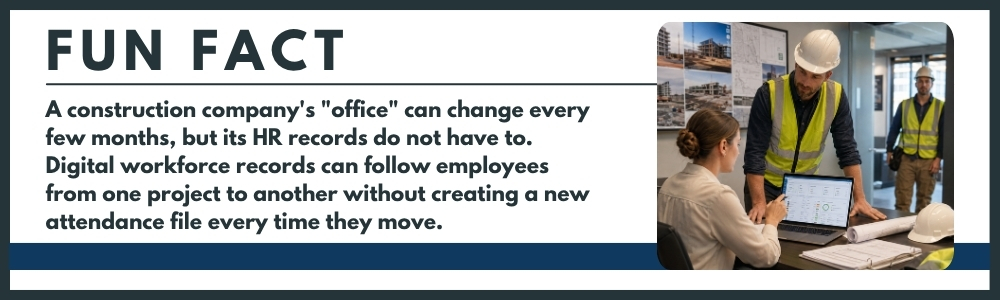
Payroll now needs to determine which records belong to the same person. HR should not have to reconstruct an employee's month from different site spreadsheets. With Construction HR software, employee information can remain connected to one employee profile even when the person's work location or assignment changes. HR can maintain information such as:
- Employee ID
- Contact information
- Department
- Designation
- Reporting manager
- Employment status
- Shift
- Attendance
- Leave
- Salary information
- Relevant documents
The project may change. The employee record should not become fragmented every time it does.
Attendance Is Harder When the Workplace Keeps Moving
Attendance is one of the biggest HR challenges in construction. In an office, an employee normally reports to the same location every day. A construction worker may not be. This makes a paper attendance register difficult to depend on across multiple sites. A typical process might look like this:
- A supervisor marks attendance at Site A.
- Another supervisor maintains a different register at Site B.
- At the end of the week, someone photographs the registers.
The images are sent to HR.
HR enters the information into a spreadsheet. Payroll later uses that spreadsheet to calculate wages. Every handoff creates another opportunity for an error. Contractor attendance software can help move attendance closer to where work actually happens.
Instead of waiting for physical registers to reach HR, attendance can be captured digitally and made available to authorized teams. That becomes particularly useful when a company operates several projects at the same time.
Geo Attendance: Was the Worker Actually at the Job Site?
Construction does not have one permanent front door where everyone clocks in. The job site is at the workplace.
Geo Attendance can help companies define where employees are permitted to record attendance. When used according to company policy and applicable privacy requirements, location-based attendance can help HR verify that attendance is being recorded from an approved work location.
For example:
Site A: Approved attendance area
Site B: Approved attendance area
Head Office: Approved attendance area
An employee assigned to Site B should not need to travel to the main office simply to record attendance.
This is one area where contractor attendance software combined with mobile access can make field attendance much more practical.
Construction of HR platforms increasingly include mobile time tracking and geo-fenced attendance because workers are distributed across different job sites rather than sitting at centralized offices.
For HR, this creates better visibility.
For supervisors, it reduces paperwork.
For payroll, it provides cleaner attendance information.
Different Sites May Need Different Shifts
Not every construction project follows the same working schedule.
One project may operate: 7:00 AM to 4:00 PM
Another may run: 8:00 AM to 5:00 PM
A time-sensitive project may introduce:
Day Shift: 6:00 AM to 2:00 PM
Evening Shift: 2:00 PM to 10:00 PM
Now imagine maintaining all of those assignments manually. HR needs to know which employee belongs to which shift and whether attendance corresponds with that schedule.
Shift Management can support construction workforce management by giving companies a clearer way to assign and maintain working schedules.
When an employee moves between projects, their relevant work schedule can also be managed rather than relying on verbal instructions or separate spreadsheets.
Managing Salary Records for Labor
Construction payroll can involve different categories of workers. A company may employ:
- Permanent employees
- Skilled labor
- General labor
- Supervisors
- Engineers
- Site administrators
- Contract workers
- Shift-based workers
Their salary structures may not all look the same. Some employees may receive fixed monthly salaries. Others may have wage structures affected by working days, shifts, overtime, or company-specific rules. Managing this through separate spreadsheets creates another familiar problem:
What Should Construction Companies Look for in HR Software?
If a construction company is considering Construction HR software, the decision should not be based on having the longest feature list.
Start with the way people actually work.
1. Can It Manage Employee Information Centrally?
Workers may change projects, but HR should still have one dependable employee record.
2. Can Attendance Work Across Job Sites?
A construction business needs attendance processes suited to field-based employees. Contractor attendance software should help reduce dependence on paper registers and delayed site reporting.
3. Does It Support Location-Based Attendance?
Geo Attendance can be useful for organizations that need attendance linked to approved work locations.
4. Can It Manage Different Shifts?
Projects may have different schedules, and those schedules may change as construction progresses.
5. Does Attendance Connect With Payroll?
Construction payroll software should reduce repeated manual entry between time records and salary processing.
6. Can Field Teams Access It on Mobile?
A system that works only from a desktop at headquarters misses a large part of the construction workforce.
7. Can HR Generate Workforce Reports?
Good labor management software should help management understand workforce activity across locations rather than simply store employee names.
When Does a Construction Business Really Need HR Software?
You probably do not need to wait until you have thousands of workers. Look at the problems instead of the headcount. You may need Construction HR software if:
- Site attendance reaches HR late.
- Supervisors maintain separate employee spreadsheets.
- Workers frequently move between projects.
- HR struggles to identify where employees are assigned.
- Payroll corrections happen because attendance information was wrong.
- Different sites operate different shifts.
- Employee information exists in several files.
- Management lacks a clear workforce view across projects.
These are signs that the problem is no longer just paperwork. The business has outgrown disconnected workforce records.
Manage the People Behind Every Project
Every construction project depends on people showing up at the right site, at the right time, for the right shift. Managing those people should not require HR to chase attendance registers across job sites.
HR HUB brings Attendance, Geo Attendance, Shift Management, Payroll, Mobile Application, Employee Information, and Reports together to help construction businesses manage workers across different projects from a centralized HR platform.
Keep employee information connected when workers move between sites. Capture attendance closer to the job location. Manage different shifts. Maintain salary records. Give HR and management a clearer view of the workforce across active projects.
Your construction teams may work across different sites. HR information doesn't have too.