“I already emailed HR.”
Most employees have said some version of that sentence.
Maybe it was a request to correct attendance, ask for a document, clarify a payroll issue, update personal information, or get help with another workplace concern.
The employee sends the message and waits.
As the day passes, there is no reply, so they follow up. Then another question appears: Did anyone receive my request?
The frustrating part is often not the request itself. It is uncertainty that follows. Employees may not know who is handling the request, whether anything is missing, how long it might take, or whether they need to contact somebody else.
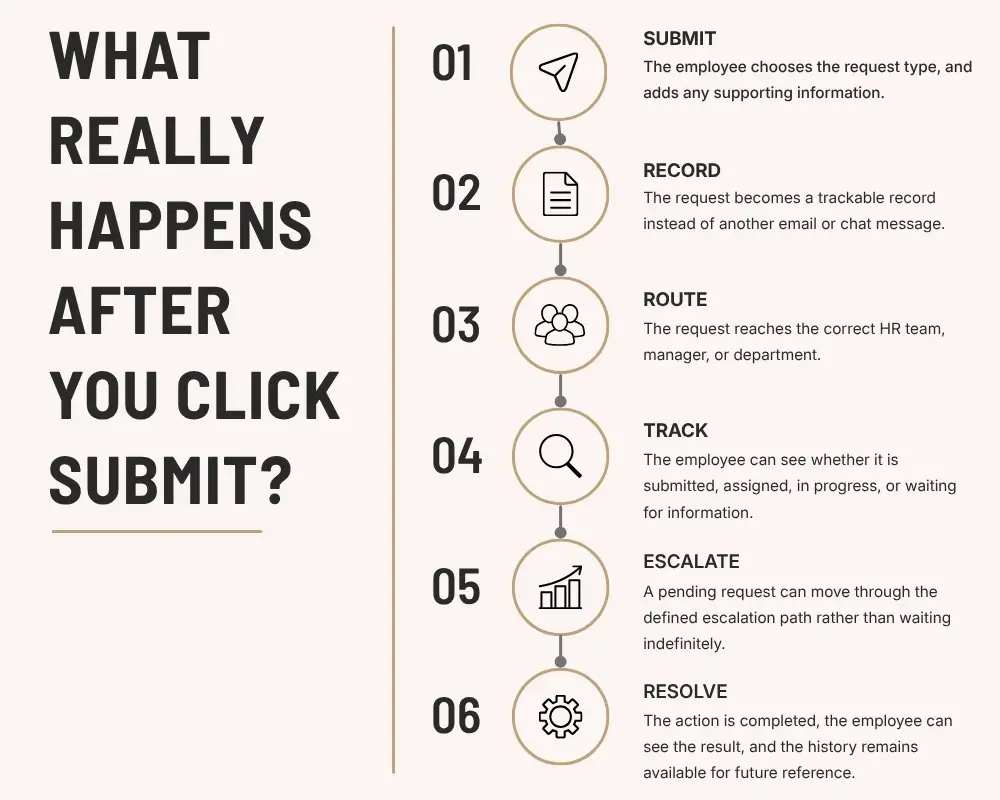
A good employee request management system changes that experience. Clicking Submit should not send a request into a digital black hole. It should begin a visible journey where the request is recorded, sent to the right person, updated, escalated when necessary, and eventually resolved with a history that remains available.
That is the difference between simply receiving employee requests and actually managing them.
Employee Service Request Should Create Something Trackable
Consider what happens when an employee sends an ordinary email.
The message reaches someone's inbox. Perhaps the subject is vague. Maybe an important attachment gets buried inside the thread. If the recipient is on leave, another HR team member might not even know the request exists.
And when the employee follows up two days later, everyone may need to search through messages to understand what happened.
An employee request management system works differently.
Once the employee submits a request, it can become a structured record containing information such as the employee's name, request type, submission date, description, supporting documents, priority, and status.
Streamlined Request Submission capability is designed to let employees submit tickets or requests through a structured process rather than depending on scattered communication.
That first step matters. The employee has not simply sent another message. They have created a request that the organization can follow. For HR request management, that gives everyone a clearer starting point.
Then the Request Needs an Owner
Submitting does not necessarily mean somebody is working on it.
The next question is: Who owns this request?
Different employee requests naturally belong to different people or departments.
- Payroll clarification may need the Finance Department.
- An attendance correction may need a manager or attendance administrator.
- A document request may belong to HR.
- A technical issue may need to be routed for IT.
An employee service request becomes difficult to manage when nobody knows who is responsible for taking the next action. This is where an HR ticketing system can create clarity by assigning the request to the appropriate team or person.
Without ownership, employees can quickly find themselves in conversations such as:
“I sent it to HR.”
“HR sent it to Payroll.”
“Payroll is waiting for approval.”
“I'm not sure who has it now.”
Good employee query management should prevent the employee from becoming the person responsible for tracing their own request through the organization.
The employee should explain the issue. The process should help it reach the right owner.
Employees Need to See What Is Happening Next
Once a request has an owner, the employee usually has another question: What is happening with it?
They may not need a detailed explanation every hour. But they should not have to guess. Simple request stages can provide useful clarity: Submitted → Assigned → In Progress → Waiting for Information → Resolved
Employee Self Service allows employees to submit HR requests and track request or approval status through a centralized portal. Employees can also access information such as leave details, payslips, and other employment information independently.
This is where an employee request management system starts affecting employee experience. When employees can see that a request has moved from Submitted to In Progress, they know someone is dealing with it.
When the status says, “Waiting for Information,” they know an action may be required from them.
When it says Resolved, they know the process has reached an outcome. Good HR request management therefore does not only help HR organize work. It removes unnecessary uncertainty for employees.
Sometimes HR Needs Something from the Employee
A request cannot always move directly from Submitted to Resolved. Perhaps an employee raises a reimbursement question but forgets the supporting receipt.
Maybe an attendance regularization request contains the wrong date. Perhaps someone asks for a document but does not explain which document they need.
At that point, HR needs clarification.
This is where the request itself should remain at the centre of the conversation. If every clarification moves into separate emails, chat messages, or phone calls, history quickly becomes fragmented again.
Better employee query management keeps important communication connected with the request wherever possible. Someone reviewing the case later should be able to understand:
- What was originally requested?
- What information was missing?
- What did HR ask for?
- When did the employee respond?
- What happened next?
This becomes particularly useful when another HR team member needs to continue the request. The employee should not have to explain the whole story again simply because someone else is now handling it.
What Happens to An Employee Service Request When Nobody Responds?
Now consider a different situation. The request was submitted correctly. It reached the right person, but nothing happens, and the employee waits then waits for even longer time.
Eventually, they send another message: “Any update?”
This is where escalation is important. Escalation does not have to mean turning every delayed request into an emergency. It simply gives the organization a defined next step when a request remains pending longer than expected.
For example, an employee service request might first be assigned to one HR team member. If no action occurs within a defined period, the request can move to another responsible person or manager.
Workflow, Request & Escalation capability supports request routing, notifications, status tracking, and escalation of pending actions. Approval Workflows can also be configured according to factors such as request type, department, role, or internal process.
This makes escalation a useful part of HR request management.
The employee should not have to become the organization's reminder system. If a request has been waiting too long, the process should make that visible.
Closing a Request Should Not Erase Its Story
Eventually, the request reaches an outcome. The attendance correction is approved. The document is provided. The payroll question is answered. A workplace issue is addressed or perhaps the request cannot be approved, but HR provides the reason.
At that stage, an employee request management system should preserve the useful history rather than making the request disappear as soon as somebody clicks Closed. A completed record may help show:
- what the employee originally requested
- when it was submitted
- who handled it
- what communication took place
- how its status changed
- when it was resolved
- what the outcome was
This is another important role of an HR ticketing system. Today's resolved question could become useful in context three months later. Instead of asking everyone what they remember, HR can refer to the request history.
HR Request Management Can Also Tell HR Where Processes Are Struggling
One ticket tells HR what one employee needs. Hundreds of tickets can tell HR something much bigger. Imagine that employees repeatedly submit the same question about payslips.
Perhaps the information is difficult to find.
If attendance correction requests suddenly increase, maybe the clock-in process needs attention. If one request category regularly takes five times longer to resolve than others, the problem may be ownership rather than request volume.
Ticket & Support Management includes visibility into areas such as ticket volume, recurring issues, response time, resolution status, and support performance.
This is where an HR ticketing system becomes more than a place to close tickets. It becomes a source of information about employee support experience.
Effective employee query management does not only ask: “How quickly did we answer this employee?”
It can also ask: “Why do employees keep needing to ask this question?”
That second question can lead to better HR communication, clearer policies, improved self-service information, or better internal processes.
Good Employee Request Management Should Feel Simple to the Employee
Employees do not need to understand the technical architecture behind HR request management. They should not need to know which internal team owns which queue, how routing rules are configured, or what happens behind every workflow.
- They care about something much simpler.
- Submitting the request should be clear.
- Waiting should feel visible.
- If something is missing, they should know.
- If the request has stalled, there should be a way forward.
- When the request is finished, the outcome should make sense.
A well-designed employee request management system helps create that experience while giving HR the structure needed to manage a large volume of requests consistently.
Strong employee query management also improves accountability without making employee support feel unnecessarily bureaucratic.
The goal is not to build the most complicated request process.
It is to stop employees from wondering: “What happened after I clicked Submit?”
Make “Submitted” the Beginning, Not the End
An employee service request should have a journey employees can understand.
- It should be recorded.
- It should reach an owner.
- Its status should be visible.
- Important communication should remain connected.
- If it waits too long, there should be an escalation path.
When it is resolved, there should be a useful history.
That is what better employee query management, and an effective HR ticketing system should ultimately provide: not simply more tickets, but a more predictable way for people to get help.
HR HUB connects Employee Self Service, Ticket & Support Management, Controlled Regularization Requests, and Workflow, Request & Escalation so organizations can create structured request journeys from submission through resolution.
Because after an employee clicks Submit, the most reassuring response is not simply: “We'll look into it.”
It is knowing that the request has somewhere to go, someone responsible for it, and a clear path toward an answer.