HR Compliance Software calculates salaries, records attendance, manages leave, and generates payslips.
But in 2026, Indian companies need to ask another question: Is our HR software updated for the Labor Codes that apply to our workforce?
India's four Labor Codes came into effect on 21 November 2025, consolidating 29 Central labor laws into four codes:
- Code on Wages, 2019
- Industrial Relations Code, 2020
- Code on Social Security, 2020
- Occupational Safety, Health and Working Conditions Code, 2020
The new labor codes affect areas HR already manages every day, including wages, overtime, attendance, employment records, social security, gratuity, maternity benefits, appointment letters, shifts, registers, and reporting.
That makes HR compliance software for India labor codes more than a payroll tool.
A company should not have one process for attendance, another spreadsheet for overtime, separate payroll calculations, employee documents buried in folders, and compliance records reconstructed whenever someone asks for them.
The HR system should help bring these records together.
And in 2026, companies evaluating HR technology should ask a simple question: Does our software actually support the compliance environment we operate in?
HR Compliance Software Is Not Just Payroll Software
Compliance begins much earlier than salary processing. Imagine an employee working two additional hours.
- The attendance system records the hours.
- The manager approves overtime.
- Payroll uses those hours for the applicable calculation.
- The payslip reflects the result.
- The organization retains records.
If someone later asks how the amount was calculated, HR can trace what happened. That is a compliance process.
Now imagine attendance is recorded in one application, overtime approvals happen over WhatsApp, payroll is maintained in a spreadsheet, and employee salary information exists in another system.
The company may eventually arrive at the right number.
But proving how it arrived there becomes much harder.
Good HR compliance software should connect the HR activities that create compliance records rather than treating compliance as something HR checks after payroll is complete.
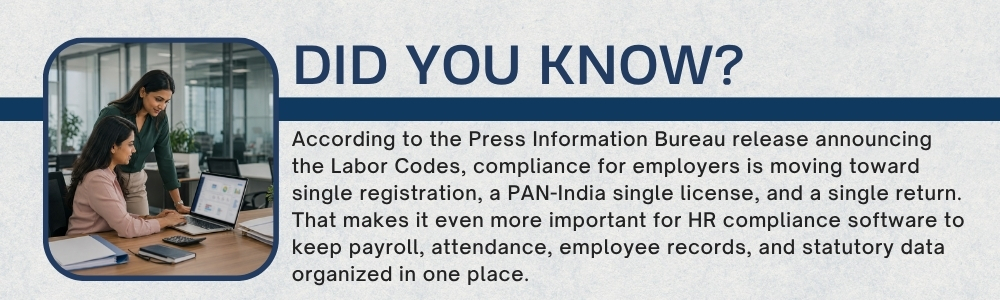
For Indian businesses, that means the system should be capable of supporting requirements arising from the new labor codes India, along with applicable rules, notifications, state requirements, and other statutory obligations relevant to the employer.
What Companies Must HR Compliance Software in India?
There is no useful "compliance" button that can solve every legal requirement. A practical system needs several connected capabilities. For companies evaluating HR compliance software for India labor codes, these are the areas worth examining closely.
1. Code on Wages: Payroll Needs to Follow the Rules, Not Just Calculate Salary
The Code on Wages affects some of the most frequent HR activities.
Employers need to consider applicable minimum wages, wage periods, payment deadlines, overtime, authorized deductions, wage slips, and prescribed records.
For a monthly wage period, the Ministry's handbook states that wages must be paid before the expiry of the seventh day of the succeeding month.
When an employee resigns, is dismissed, or is terminated, due wages must generally be paid within two working days.
The Code also provides overtime at a rate of at least twice the normal rate of wages where the applicable conditions are met.
This means payroll compliance software should work with verified attendance and overtime data.
If attendance records overtime but payroll never receives it, the process breaks.
If managers approve overtime through messages and HR manually adds the amount to payroll, the company becomes dependent on manual intervention.
HR compliance software for India labor codes should connect working hours, approved overtime, salary components, deductions, and payroll history so HR can trace how an employee's pay was calculated.
Your Payroll System Needs a Configurable Definition of Wages
The new labor codes also make salary structure more important.
The statutory definition of wages includes basic pay, dearness allowance, and retaining allowance, if any, while certain other components are excluded subject to the provisions of the Codes.
The Ministry's guidance also explains the 50% rule. Where specified excluded remuneration exceeds 50% of total remuneration, the excess is added back for the purpose of determining wages.
For HR teams, this means salary components cannot simply exist as unrelated columns in a spreadsheet.
Good payroll compliance software should allow HR to configure components such as:
- Basic pay
- Dearness allowance
- Allowances
- Bonus
- Overtime
- Commission
- Deductions
- Employer and employee contributions
- Other applicable components
It should also preserve previous salary structures.
When statutory treatment changes, HR compliance software should allow authorized teams to update the applicable configuration without rebuilding payroll formulas from scratch.
Attendance and Overtime Records Need a History
Under the Code on Wages, employers need to maintain prescribed records relating to areas such as attendance, wages, overtime, fines, and deductions.
The code says that applicable registers may be maintained electronically, and records under the Code on Wages are to be preserved for five years.
That makes attendance more than a punch-in and punch-out system. Labor law compliance software should help maintain:
- Attendance
- Working hours
- Shift assignments
- Overtime
- Weekly offs
- Holidays
- Attendance corrections
- Approval history
This becomes particularly relevant for manufacturing, retail, restaurants, healthcare, hospitality, logistics, and businesses operating multiple shifts.
If an attendance record is corrected after payroll, HR should be able to understand what changed and how that change was handled.
Employee Exit Should Trigger the Right HR Actions
An employee resigns. HR updates their status. But what happens next?
The Code on Wages includes timelines for payment of due wages after resignation, dismissal, or termination. Gratuity can have its own payment timeline where applicable.
A connected HR compliance software system should allow employee exits to feed relevant Full & Final, attendance, leave, payroll, and document processes.
The exit date should not sit in an employee profile while payroll waits for someone to email the information.
2. Code of Occupational Safety, Health & Working Conditions Code
Under the OSH&WC Code, employers are required to issue appointment letters to employees.
That makes document management another area companies should review when evaluating HR compliance software for India labor codes.
An employee profile should be able to maintain relevant information such as:
- Joining date
- Employment category
- Designation
- Department
- Work location
- Appointment letter
- Salary information
- Employment status
- Transfer history
- Exit information
If HR needs an appointment record two years later, finding it should not depend on searching old emails or asking the manager who originally hired the employee.
A centralized employee record creates a more reliable source for payroll, attendance, leave, benefits, and compliance processes.
Shift and Night-Work Records Matter Too
The OSH&WC Code permits women to work in all establishments and types of work. For work before 6:00 a.m. or after 7:00 p.m., applicable requirements include employee consent and prescribed conditions relating to safety, working hours, holidays, and other safeguards.
An HR system cannot provide workplace safety. It can, though, maintain records supporting the company's process. For example:
- Employee shift
- Work location
- Scheduled hours
- Actual working hours
- Attendance
- Relevant approvals or records
For companies running multiple or night shifts, labor law compliance software should make historical schedules and working-time records easier to retrieve.
3. Code of Social Security Requires Payroll and Employee Data to Connect
The Code on Social Security brings areas such as EPF, ESI, gratuity, maternity benefits, and employee compensation under a broader framework.
From an HRMS perspective, these requirements depend on accurate employee and payroll data.
Your labor law compliance software should help maintain applicable information such as:
- Employee category
- Joining and exit dates
- Wage information
- Statutory configurations
- Contribution records
- Eligibility information
- Payroll history
Applicability can vary based on the establishment, employee, threshold, government rules, and other factors. The software should not guess which provision applies.
Once the company establishes its requirements, payroll compliance software should provide a controlled way to configure and apply them consistently.
Gratuity Needs Service and Employment History
The Social Security Code is also relevant to gratuity. It states that fixed-term employees can become eligible for gratuity on termination of the contract period after completing one year of service.
Where gratuity becomes payable, the handbook states it must be paid within 30 days.
That means an HRMS needs more than the employee's current salary.
HR compliance software for India labor codes should be able to maintain employment type, joining date, service history, wage history, contract details, and exit information.
If the system cannot distinguish a fixed-term employee from another employee category, HR may need to reconstruct the calculation manually when the employee leaves.
Maternity Benefits Connect Leave, Employee Records and Payroll
Maternity compliance is another example of why HR modules should not operate separately.
The law states that an eligible woman employee who has worked for at least 80 days during the preceding 12 months can qualify for maternity leave benefit, with the Code providing up to 26 weeks in applicable cases.
There are also provisions concerning miscarriage, medical termination of pregnancy, nursing breaks, and crèche facilities where applicable.
The process can involve: Employee information → eligibility → leave → payroll treatment → records.
Good HR compliance software should help HR keep those records connected rather than managing maternity leave in one file and its payroll impact in another.
4. Industrial Relations Codes Needs Records Beyond Payroll
Not every requirement under the new labor codes concerns salary.
The Industrial Relations Code covers areas including grievance redressal, standing orders, service conditions, industrial disputes, retrenchment, lay-offs, and closure.
The Ministry handbook notes, for example, Grievance Redressal Committee requirements for industrial establishments with 20 or more workers, while provisions concerning standing orders apply to industrial establishments with 300 or more workers.
Depending on applicability, an HR system can help maintain employee classifications, grievance records, policies, documents, notices, and employment histories.
This is why HR compliance software for India labor codes needs to go beyond payroll calculations.
Why Companies Need HR Compliance Software in 2026
The strongest reason is not that HR teams need more technology.
They need fewer opportunities for compliance information to break between processes.
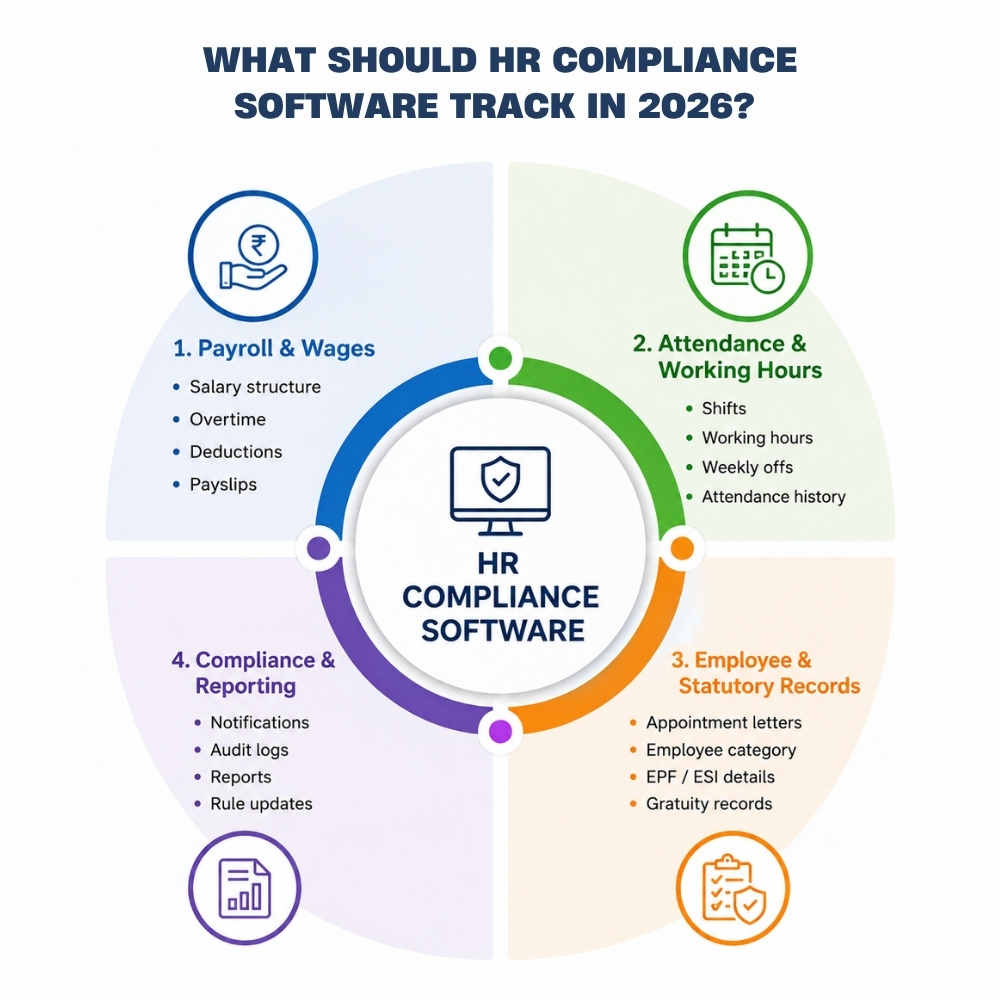
- Attendance affects working hours.
- Working hours can affect overtime.
- Leave affects attendance.
- Employee information affects payroll.
- Payroll feeds statutory calculations.
- Configuration determines how rules are applied.
- Reports depend on all of them.
- Audit history explains what happened later.
When these processes operate separately, HR spends time checking, copying, reconciling, and correcting information.
The new labor codes India make this connected approach especially relevant because multiple HR activities can contribute to an employer's compliance obligations.
For organizations reviewing labor codes India 2026, the question should not simply be:"Does our payroll software calculate salary?"
Ask:"Can our HR system support the records, configurations, controls, and reporting our compliance process requires?"
That is a much better test.
Labor Codes India 2026: Your Software Needs to Be Ready for Change
Compliance configuration should never be treated as "set it once and forget it."
That means businesses following labor codes India 2026 need to keep monitoring official sources and review their HR configurations when applicable requirements change.
A configurable system makes that process more manageable.
Instead of rebuilding payroll formulas, leave rules, employee categories, or reports from scratch, HR can review the relevant configuration and update it through a controlled process.
For current government information, businesses should follow the Ministry of Labor & Employment Labor Codes portal.
Is Your HR Software Ready for India's Compliance Requirements?
Take a look at your current system.
- Can it connect attendance with payroll?
- Can it maintain employee employment history?
- Can you configure wage components?
- Can you track overtime?
- Can employees manage leave through a controlled process?
- Can statutory settings be configured?
- Can you retrieve historical payroll records?
- Can you see who changed important employees or payroll information?
- Can you generate reports without rebuilding the data manually?
If several answers are "no," compliance may still depend too heavily on spreadsheets, emails, manual calculations, and individual employees remembering what to do.
That is precisely where HR compliance software for India labor codes can make a difference.
Put Compliance Behind Everyday HR Processes
Compliance should not begin at the end of the month when payroll is due. It begins when an employee joins.
- When their information is recorded.
- When they attend a shift.
- When they work overtime.
- When they take leave.
- When their salary changes.
- When payroll is processed.
And when those records need to be reviewed later.
HR HUB brings Employee Information, Attendance, Leave, Payroll, Compliance Configuration, Reports, and Audit Logs together, so the records behind HR compliance are managed through connected processes.
For companies adapting to the new labor codes India, that means less dependence on disconnected spreadsheets and more control over the data used across HR and payroll.
The legal requirement still belongs to the employer.
The software should make following, documenting, and reviewing that requirement far easier.