Payroll is one of those business functions that everyone expects to work perfectly, until something goes wrong.
- An employee receives a lower salary than expected
- A tax deduction is missed
- Overtime is calculated incorrectly
- The bank file contains the wrong account number
- A payslip reaches the wrong employee
Suddenly, payroll became the most talked-about department in the company.
Whether a business has 20 employees or 2,000, paying people accurately and on time is not optional. It directly affects employee trust, legal compliance, and the company's reputation. This is why businesses often reach crossroads.
Should payroll be outsourced to an external service provider?
Or
Should payroll be managed internally using modern HR software?
Both approaches can work, have advantages, and also have challenges.
The right decision depends on the size of the organization, the level of control the business wants, the complexity of payroll, and its long-term growth plans.
In recent years, another factor has entered the conversation.
Modern payroll management software has become far more intelligent than traditional payroll systems. In place of simply calculating salaries, it now connects attendance, leave, employee information, statutory compliance, reports, reimbursements, and approvals into one centralized platform.
As a result, many businesses that previously relied on payroll outsourcing are now reconsidering whether they should manage payroll internally with the right technology.
Before comparing both options, it helps to understand what payroll processing actually involves.
What Is Payroll Processing?
Many companies think payroll processing simply means transferring salaries to employees every month. However, it is a structured process involving multiple activities that need to work together accurately. A general payroll cycle includes:
- Collecting attendance and working hours
- Calculating overtime and shift allowances
- Processing leaves deductions
- Applying bonuses and incentives
- Calculating taxes and statutory deductions
- Processing reimbursements
- Generating payslips
- Preparing bank transfer files
- Maintaining payroll records
- Producing compliance reports
Each step depends on accurate employee information.
- If attendance is incorrect, salary calculations become incorrect
- If leave balances are outdated, deductions become inaccurate
- If employee records are not updated, payroll may process the wrong salary
This is why businesses increasingly rely on payroll management software instead of managing these calculations manually.
Why Do Companies Outsource Their Payroll?
For many organizations, payroll outsourcing offers a practical solution. Instead of hiring dedicated payroll professionals and investing in payroll infrastructure, companies work with external specialists who manage payroll on their behalf.
The provider usually handles salary calculations, statutory deductions, payslips, tax filings, and payroll reports based on the information supplied by the company. However, this approach is particularly attractive for:
- Small businesses
- Startups
- Organizations without a dedicated payroll team
- Businesses looking to reduce administrative work
Since payroll specialists stay updated with changing regulations, many employers feel more confident handing over the responsibility. However, outsourcing does not eliminate payroll responsibility. The employer must still provide accurate employee information, attendance records, salary revisions, reimbursements, leave details, and compliance data. Incorrect input still produces an incorrect payroll.
Why More Businesses Are Moving Payroll In-House
While outsourced payroll services remain popular, many growing organizations eventually reach a stage where they want greater visibility and control. Imagine a situation:
A simple employee question now involves three different teams.
Modern payroll software India solutions eliminate much of this back-and-forth because attendance, leave, employee information, and payroll are connected within one platform.
Instead of waiting for information from multiple sources, HR can review payroll data directly before processing salaries. This reduces delays while giving businesses greater confidence in their payroll process.
Payroll Mistakes That Cost Businesses More Than Money
Payroll mistakes rarely happen, but it does, and this is because HR lacks experience. They usually occur because information is scattered across different systems or tools. Some of the most common payroll mistakes include:
- Attendance entered manually: Manual attendance increases the risk of incorrect salary calculations
- Leave balances not updated: Approved leave may never reach payroll, creating incorrect deductions
- Salary revisions processed late: An employee receives the old salary because payroll wasn't informed about the increment
- Duplicate employee records: Different departments maintain different employee information
- Overtime calculations missed: Shift changes or extra hours are forgotten before payroll closes
- Compliance updates overlooked: Tax rules or statutory deductions change, but payroll continues using old settings
These situations become much less common when payroll automation connects attendance, leave, employee information, and payroll within one system.
Payroll Outsourcing vs HR Software: Comparing the Real Cost
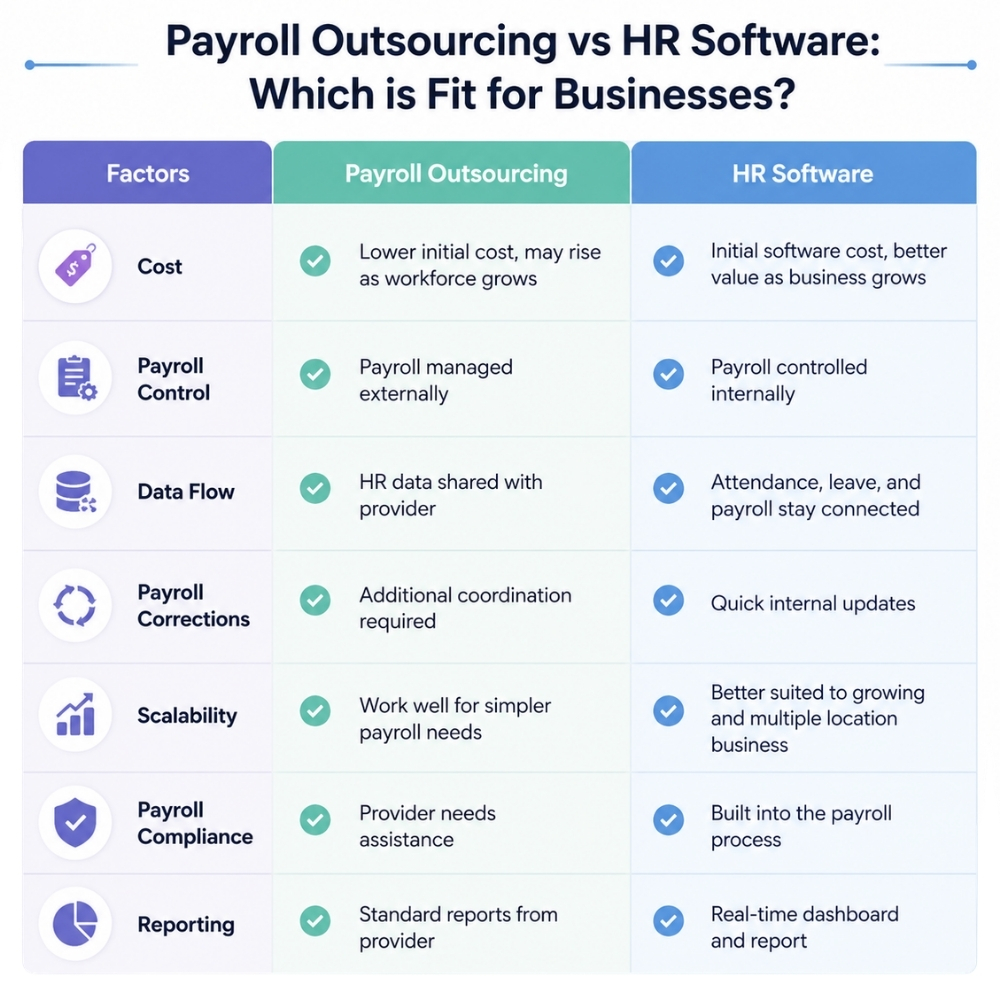
When businesses compare payroll outsourcing with an in-house payroll solution, the first thing they usually compare is the monthly price.
At first glance, outsourcing often appears less expensive because there is little upfront investment. The payroll provider handles calculations, statutory deductions, payslips, and payroll processing, allowing HR teams to focus on other responsibilities.
However, the monthly service fee is only one part of the total cost.
As the business grows, payroll becomes more complex. Employee numbers increase. Salary revisions are becoming more frequent. Shift patterns change. Multiple pay structures are introduced. HR starts requesting more reports, corrections, and customized payroll calculations. Each of these requirements may increase the cost of outsourced payroll services.
With payroll management software, the business invests in its own payroll infrastructure. Although there may be an initial implementation cost, the software continues supporting payroll as the organization grows. Since attendance, leave, employee information, reimbursements, and payroll remain connected, HR spends less time preparing payroll every month.
The real comparison is not simply monthly cost versus software subscription. It is whether your payroll process becomes more efficient, scalable, and easier to manage over the next several years.
Payroll Outsourcing
- Lower upfront investment.
- Payroll experts manage salary calculations.
- Monthly service charges.
- Additional requests may increase costs.
- Limited flexibility for custom business requirements.
HR Software
- Higher initial setup compared to outsourcing.
- Predictable software subscription.
- Lower administrative costs over time.
- Supports long-term business growth.
- Better return on investment as employee numbers increases.
Payroll Outsourcing vs HR Software: Who Has More Control?
One of the biggest differences between payroll outsourcing and using payroll software India is control.
When payroll is outsourced, the company shares attendance records, leave information, salary revisions, reimbursements, bonuses, and employee details with an external payroll provider. The provider processes the payroll and returns the reports.
This works well when payroll rarely changes. But modern workplaces are dynamic.
- Employees receive promotions
- Salary revisions happen mid-month
- Attendance corrections arrive after payroll preparation has started
- Leave approvals change
- Overtime gets approved late
Each update requires communication between HR and the payroll provider.
That process can slow down payroll. With payroll management software, HR teams work directly inside the same platform where employee information, attendance, leave, approvals, and payroll already exist.
Instead of sending spreadsheets back and forth, HR can review the information immediately before payroll is finalized.
This gives businesses greater visibility and much faster decision-making.
Payroll Outsourcing
- Payroll processing is managed externally.
- HR depends on provider timelines.
- Employee information is shared with a third party.
- Payroll corrections usually require additional communication.
- Limited visibility during payroll processing.
HR Software
- Payroll remains completely under company control.
- HR can review payroll before processing.
- Real-time payroll visibility.
- Faster corrections.
- Better coordination between HR, payroll, and managers.
Payroll Outsourcing vs HR Software: Accuracy and Payroll Errors
Payroll accuracy depends on the quality of the information used to calculate salaries.
Even experienced payroll professionals cannot calculate correct salaries if attendance records are incomplete or leave information is inaccurate.
When outsourced payroll services receive incorrect information, the payroll output is also incorrect.
Corrections often mean another round of communication, revised calculations, and updated payslips.
Modern payroll automation reduces these risks because payroll is connected directly with attendance, leave management, employee information, reimbursements, and salary structures.
Instead of entering the same information multiple times, HR works from one centralized database. That reduces duplicate records and minimizes manual errors.
Payroll Outsourcing
- Depends on the accuracy of information provided by HR
- Payroll corrections often require another processing cycle
- Manual file sharing increases the possibility of missing information
- Delayed updates can affect salary accuracy
HR Software
- Attendance flows directly into payroll.
- Leave balances update automatically.
- Employee information remains centralized.
- Fewer manual calculations.
- Payroll can be reviewed before salaries are processed.
Payroll Outsourcing vs HR Software: Compliance and Reporting
Payroll is no longer just about paying salaries. Organizations must also comply with statutory regulations, maintain payroll records, prepare audit reports, and respond to employee queries.
With payroll outsourcing, businesses usually receive reports after payroll has been processed. If management requests a custom report or wants additional payroll analysis, HR often needs to coordinate with the service provider.
A centralized payroll management software solution allows HR teams to generate payroll reports whenever required. Managers can review payroll summaries, department-wise salary costs, statutory deductions, overtime expenses, and employee earnings without waiting for external reports.
For growing businesses, this visibility supports faster financial planning and better workforce decisions.
Payroll Outsourcing
- Standard payroll reports.
- Custom reports may require additional requests.
- Compliance support depends on the provider.
- Limited real-time payroll analytics.
HR Software
- Instant payroll dashboards.
- Real-time reporting.
- Easier audit preparation.
- Better financial visibility.
- Connected HR and payroll reporting.
Payroll Outsourcing vs HR Software: Which One Fits Your Business?
Neither option is universally better. The right choice depends on where your business stands today and where it plans to be tomorrow.
Payroll Outsourcing is often suitable if your business:
- Has fewer employees.
- Runs a relatively simple payroll process.
- Does not have an internal payroll specialist.
- Wants external payroll expertise.
- Has limited HR resources.
HR Software is often a better choice if your business:
- Is growing rapidly.
- Operates multiple branches or locations.
- Manages shift-based employees.
- Requires payroll to work closely with attendance and leave.
- Wants greater visibility and control.
- Plans to automate more HR processes in the future
Why Growing Businesses Choose HR HUB
Managing payroll should not feel like a monthly race against deadlines.
HR HUB combines Payroll, Employee Information, Attendance, Leave, Compliance, and Reports into one centralized platform, helping HR teams process payroll with greater accuracy and visibility.
Whether you're comparing payroll outsourcing with in-house payroll or planning to modernize your HR operations, HR HUB gives you the tools to automate routine work, reduce manual errors, strengthen compliance, and keep every payroll cycle running smoothly.
Because payroll isn't just about paying employees. It's about building confidence in every paycheck.